


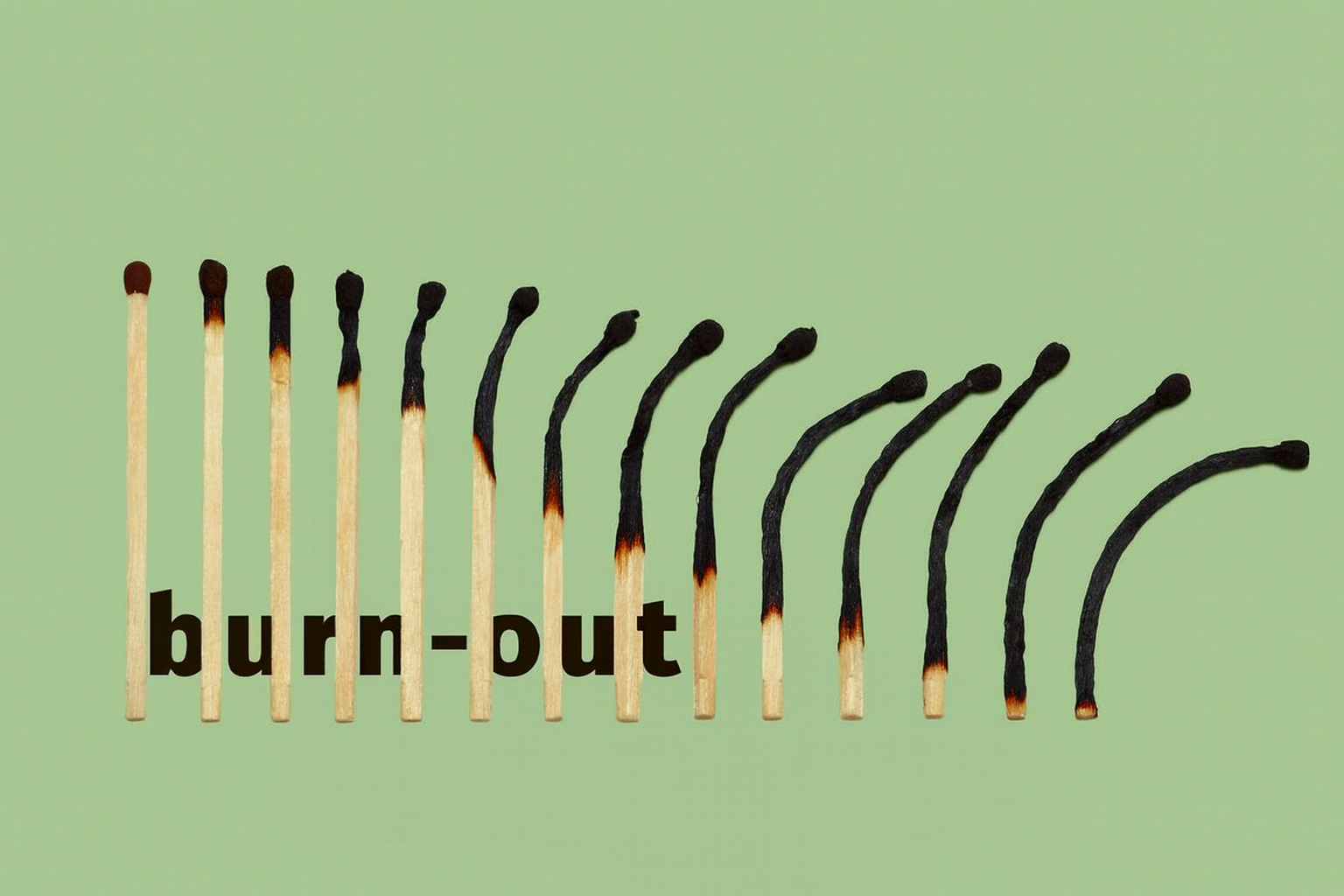
Are you burned out, or sliding into it? If so, you’re probably a go-getter who’s been operating at a top-performance level — someone who kept pushing through stress and tension, went beyond their limits, and eventually collapsed feeling completely drained. Sound familiar?
Now it also makes sense why warnings about burnout don’t work: you don’t recognize the stress signals yourself — the people around you often do.
It’s important to acknowledge the fatigue and take rest when your body asks for it.
Exhaustion, cynicism (a shift toward negativity), and reduced self-confidence are key indicators of burnout.
The terms “overstressed” and “burnout” are often mixed up. The symptoms look similar.
Three Characteristics of Burnout
Symptoms appear suddenly and can trigger a shock or anxiety response.
It’s a normal, healthy reaction of your body and mind to long-term depletion. With full acceptance, it typically resolves on its own within 2–6 months.
It is maintained by fear and uncertainty — about your health, your work, your future — and by a lack of insight into the real causes of being burned out.
Therapy
Burnout therapy consists of 10 sessions, following the sequence described below, focused on strengthening the self-healing capacity of body, essence, and mind. Each program is personalized — everyone has different pitfalls and symptoms — but the overall structure remains the same.
It is recommended to start a mindfulness training as soon as possible. Depending on your energy level, you can choose from:
A standard 8-week mindfulness course (2.5 hours per session, usually in the evening)
An 8-week individual mindfulness training (I-MBCT), 75 minutes per session, scheduling by arrangement
An 8-week burnout-specific mindfulness training (2 hours per session), tailored to burnout, offered during the day and in the evening
All options and prices can be found under the “Agenda” and “Offerings” tab.
What a Burnout Program Looks Like
Start: Getting a Grip by Facing Reality
Session 1: Flipping the Switch
The switch of fear, insecurity, and feeling like a failure pulls you into a downward spiral fast. That’s why the first step is to flip that “negative switch” into a positive one — shifting you into an upward spiral.
The “wake-up call switch” is an important signal from your own inner harmony system, which simply wants you to be happy. Now you have the opportunity to take the lead and reshape your life in a way that fits you and brings fulfillment. This allows you to emerge from burnout stronger and more whole than before.
Next: Learning What Stress Is and How to Manage It
Sessions 2, 3, 4, and 5
Thought Management
Learning to manage your thoughts is essential in recovering from burnout. Thoughts play a crucial role in the development, treatment, and prevention of burnout. They are incredibly powerful.
Research shows that 45–65% of the effectiveness of antidepressants is due to the patient’s belief in their benefit. Brain scans show that patients taking a placebo for six weeks exhibit the same changes in brain activity as those taking the actual medication.
Believing something will help is already a major step.
Recognizing Stress-Inducing Thinking Patterns
Understanding the underlying causes.
Recognizing them in the future so you can choose not to be driven by them.
Recognizing Yourself in These Risk Groups:
Perfectionistic
(Overly) strong sense of responsibility
Insecure
Fear of failure
Not assertive
Need to control everything
Poor at setting boundaries
What these traits have in common is a specific thinking style — a pattern. These descriptions do not define who you are, but how you behave. Behavior can change by shifting the thought patterns that drive it.
This isn’t easy — but it is possible when you understand why it matters.
How Thought Patterns Develop
Behavior stems from thoughts: about yourself, others, how you “should” behave, what works for you, and what doesn’t. Most thought patterns originate in early childhood experiences. The examples modeled by caregivers also play a major role today.
If you learned to be a perfectionist as a child, that won’t change as long as you continue thinking like one.
Steering Your Thinking
We have about 6,000 thoughts per day, most of them unconscious, and 85% are negative.
You can’t stop them, but you can learn to steer a few of them by becoming aware of your thoughts in important moments — especially the ones that drag you down and make you vulnerable to burnout.
Recognizing physical signals that indicate unhelpful thought patterns gives you the chance to adjust those thoughts so they have a positive impact on your life and current situation.
Worrying Is Not Thinking
Worrying is endlessly repeating the same thoughts without conclusion. Thinking leads to solutions; worrying leads to sleeplessness. It’s a learned habit — and it can be unlearned, though it takes perseverance.
Here’s the kicker:
50% of what we worry about never happens
30% has already happened
12% concerns what others might think
4% lies outside our control (health, death, etc.)
4% concerns things we can influence
Worrying about the other 96% is pure wasted energy.
Finding Fulfillment in Life and Work
Sessions 6, 7, and 8
Topics include:
(Re)discovering and developing healthy beliefs, values, and norms
What truly matters to you
Your strengths and pitfalls
Whether your current work still suits you, and what needs to change
The Result
Perfectionism becomes healthy effort that doesn’t drain you
Excessive responsibility turns into caring for yourself first — and from there, others
Insecurity becomes confidence
Fear of failure becomes courage
Lack of assertiveness becomes ease in standing up for yourself
Control issues shift into letting go
Boundary-setting issues transform into knowing what’s good for you and acting from inner strength
Looking Back at Your Burnout: Keeping a Finger on the Pulse
Sessions 9 and 10
Topics include:
How are you doing physically, mentally, and in your essence?
Do you understand your vulnerabilities?
What’s going well? Where do you still need support, and from whom?
The program ends with a short written evaluation by you.
This evaluation is meant for you and the therapist — not for your employer unless you choose to share it.
You can use it later whenever stress starts taking over, as a reminder of the tools you’ve learned.
Evaluation Questions
If helpful, you can reflect on:
The most important thing you’ve learned
How you look back on the development of your burnout
What has changed in your personal and work life
What you missed in the process
Whether you would recommend the program to others
Where you still need support
Who and what in your environment can support you now and in the future
Why Mindfulness Exercises Are Effective in Burnout Therapy
When you can barely think clearly, it’s crucial to regain clarity so everything important can reach you again. That’s when you can start enjoying pleasant sensory experiences. This is called identifying and clearing sensory “noise.”
In computer terms: “cleaning the disk.”
Mindfulness helps you distinguish between direct (sensory) experience and constructed (distorted) perception — the “noise.”
This helps you recognize when too much noise is building up, how to handle it, and how to enjoy everyday life more.
Mindfulness practices increase awareness so you notice sooner when negative thoughts start shaping your emotions and behavior. By practicing daily, this new way of paying attention becomes natural.
This brings lasting change. It clears your mind and energizes your body. You’ll find yourself more resilient, better able to set and reach goals, and more steady when life throws challenges your way. And your environment will respond differently because you have changed from within.
If you’d like, I can also format this into a cleaner article or web-page layout — just say the word.